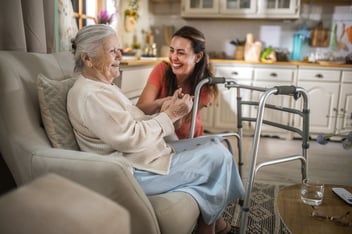



When a loved one begins showing signs of cognitive change, families often find themselves navigating unfamiliar territory. Routines become harder. Confusion and agitation increase. The familiar ways of helping no longer work—and what once felt manageable starts to feel overwhelming.
That’s usually the moment families begin asking an important question:
“What’s the difference between memory care and dementia care—and which one does my loved one need?”
If that’s you, you’re not starting from scratch. You’ve already tried things. You’ve adjusted routines. You’ve pieced together care. And now you’re looking for support that truly understands how a changing brain works.
This guide will help you understand the distinction—and why the right model of care can bring more peace to your home.
What Dementia Care Usually Means: Help With Daily Living
“Dementia care” is a broad term, but in everyday use, it often refers to traditional home care—caregivers who assist with:
- Bathing and dressing
- Meal preparation
- Transportation
- Safety
- Companionship
These caregivers are dedicated and hardworking. But the model itself is built primarily for general aging support, not the unique behavioral, sensory, and neurological needs that come with Alzheimer’s or other forms of dementia.
This is where many families notice a gap:
- The person resists care.
- Routines become triggering rather than comforting.
- Behaviors are misunderstood instead of interpreted as communication.
- Even with help, the emotional weight still falls on the family.
It’s not that the caregivers are doing something wrong—the model simply wasn’t designed for dementia.
What Memory Care Means: A Specialized Model Built for Dementia
Traditional memory care usually refers to a dedicated unit or community designed specifically for people living with dementia. These environments are intentionally structured to support the brain and reduce distress.
A true memory care model includes:
- Predictable daily rhythms
- Therapeutic engagement and meaningful activities
- Environments that reduce confusion and wandering
- Care teams trained in dementia communication, behavior patterns, and sensory needs
At its core, memory care is proactive. It anticipates needs, reduces friction, and offers the emotional stability that families desperately want their loved ones to feel.
But many families assume memory care is only available inside a facility.
That’s no longer true.
The Memory Care Model—Brought Into the Home
At Full Bloom, we bring the principles of memory care directly into the place where a person with dementia is often most grounded: their own home.
We don’t recreate a facility. We recreate the effectiveness of a memory-care environment through:
- A structured, predictable day that reduces decision fatigue
- Sensory and emotional support that calms instead of overwhelms
- Activities matched to cognitive strengths, not deficits
- Caregivers trained to read behavior as communication
- Consistent staffing to prevent the setbacks caused by constant turnover
This is the level of support families hope for when they first try traditional home care—but don’t always receive.
Why Families Turn to Memory Care at Home After Home Care Isn’t Enough
By the time a family is searching for specialized memory care at home, they’ve often reached the point where:
- Home care is inconsistent
- Behaviors are escalating
- They’re managing crises instead of enjoying time together
- Nights are hard
- Routines have broken down
- They’re exhausted from trying to hold everything together
What they need is not more hours—they need a different model.
A memory-care-at-home approach restores something that often feels lost:
Predictability.
Relief.
A calmer rhythm in the home.
A Lake Forest, IL Story: When Memory Care at Home Changed Everything
A family in Lake Forest had been caring for their mother, who was living with mid-stage Alzheimer’s. They hired a traditional home care agency, hoping the extra support would stabilize things.
Instead, the opposite happened.
- Caregivers arrived late—or didn’t show up at all.
- Some became overwhelmed by pacing and anxiety.
- A few quit without notice after difficult shifts.
- Every transition made their mother more agitated.
- The family felt constantly on edge.
Believing they were out of options, they began touring memory care communities. The thought of uprooting her felt wrong, but staying home felt impossible.
Everything changed when they discovered Full Bloom.
With consistent dementia-trained caregivers, a structured daily flow, and engagement tailored to her cognitive strengths:
- Evenings became calmer.
- Her agitation decreased.
- The family felt supported for the first time in months.
- And—most importantly—she remained safely in the home she loved.
They realized they didn’t need to choose between home and memory care.
They simply needed a model designed for dementia.
How to Know Which Level of Care Your Loved One Needs
Ask yourself these questions:
- Is your loved one experiencing agitation, pacing, wandering, or resistance to care?
- Does your current support feel reactive rather than stabilizing?
- Does your loved one settle best when routines are predictable?
- Are caregivers struggling to redirect or meaningfully engage them?
- Are you still carrying most of the emotional and logistical load?
If you’re nodding “yes,” it may be time for a memory care approach—even if your loved one remains at home.
The Bottom Line: What Families Should Understand
- Dementia care supports daily tasks and safety.
- Memory care is a specialized model built around the needs of dementia.
- Full Bloom brings the memory care model into the home—offering structure, training, and consistency designed to reduce distress and bring calm back to daily life.
When the care model matches the needs of the brain, families often notice an extraordinary shift: the home becomes peaceful again.
Frequently Asked Questions
Is memory care only available in a facility?
Traditionally, yes. But the principles behind memory care can be successfully brought into the home. Full Bloom uses compassionate, dementia-trained caregivers, structured routines, and therapeutic engagement to create memory-care-level support where your loved one feels most comfortable.
How do I know if home care is no longer enough?
Families often see escalating agitation, nighttime confusion, wandering, or overwhelming caregiver stress. When general home care can’t stabilize the day, a memory-care-informed model is often the next step.
What makes memory care at home different from rotating caregivers?
Consistency and specialization. Instead of reacting to behaviors, Full Bloom uses a proactive structure designed to prevent distress, support emotional safety, and maintain cognitive strengths.
Can this help with agitation or resistance to care?
While no approach removes every challenge, a structured dementia-informed model typically reduces agitation, improves engagement, and helps the person feel more secure—often resulting in a calmer household.