


A Note from Jennifer Muskat, Co-Founder
"How are you going to care for my loved one when they don't think they need help?"
It's a question we hear in almost every conversation with a new family. Not how do we schedule visits or manage medications, but this one, the one that keeps families up at night. Because the hardest part of memory care isn't the diagnosis. It's caring for someone who looks you in the eye and insists nothing is wrong, while you watch them struggle in ways they can't see themselves.
That's not stubbornness. It's dementia changing how the brain understands itself. And it means the usual playbook of reasoning, reminding, and convincing doesn't work. You need a different way in. The goal isn't to convince someone to accept care. It's to create a relationship where care feels natural.
That's exactly what the Full Bloom Approach was built to solve. It's five commitments we make with every family: start with the life story, introduce care thoughtfully, build a consistent team, design the day around engagement, and guide families as things evolve. At the center of it is something families rarely expect: therapeutic storytelling, a believable reason for a Memory Care Partner to simply be there, grounded in who your loved one has always been, so it doesn't feel like help arriving. It feels like a friend showing up.
This month, we're showing you the whole picture, and a closer look at exactly how it works.
Jennifer Muskat
Co-Founder & Chief Client Officer, Full Bloom Memory Care
The Full Bloom Approach: Our Step-by-Step Proven Process
Take Beverly.* She was 83, living with Alzheimer's, and had spent more than fifty years running her own home: gardening, cooking, hosting. Her husband Stan could see her slipping, weeks without a shower, the same clothes worn on repeat, but every offer of help turned into an argument. Beverly wasn't being stubborn. She genuinely couldn't see what Stan saw. That's not denial, it's a real neurological change, and no amount of reasoning fixes it.


So the approach started where it always does: with who Beverly was, not just her diagnosis. Her Memory Care Partner learned about the roses she tended, the identity she held onto as gardener and hostess, the things that made her feel like herself. That knowledge became the way in. Instead of announcing a bath or a task, her care partner connected first, admiring Beverly's roses, asking her to show off what she knew. Trust came before any task ever did.
From there, the day itself changed shape. Personal care got woven into familiar rhythms instead of imposed on top of them. Music from Beverly's era played in the background. Quiet time came before anything demanding. Small, steady choices, like which blouse to wear, gave her a sense of control inside a safe structure.

None of this made Alzheimer's disappear. But it changed what daily life felt like for both of them. Bathing stopped being a fight. Beverly spent afternoons in her garden again. And Stan, who'd been carrying it all alone, got some of his role back too: husband, not just caretaker.
That's the part of the Full Bloom Approach that doesn't show up in a bullet list: it's not just about the person living with dementia. It's about giving the whole family room to breathe.
*This story is based on the real experiences of families we've served. Names, identifying details, and images have been changed to protect their privacy.
Would you like a copy of the Full Bloom Approach?
If this method resonates with you, we'd be happy to send you a copy of the Full Bloom Approach. It walks through each step of how we build trust, thoughtfully introduce care, and support families as dementia changes over time. Simply reach out, and we'll send it your way.
August Community Events
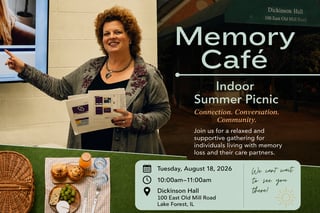
Memory Café at Dickinson Hall
Tuesday, August 18th, 10:00am - 11:00am
Dickinson Hall, 100 E Old Mill Rd, Lake Forest, IL 60045
Join us for a morning of music, connection, and sunshine! Full Bloom's Director of Client Care and Training, Colleen Hagan, will be hosting this month's Memory Café at Dickinson Hall.
We'll kick things off with a music warm-up to set the mood, move into a picnic social full of good food and easy conversation, get moving with some summer games, then wind down with music and connection to close out the morning.
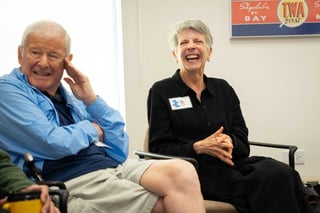
Mind Matters
Tuesdays & Thursdays, 10:00am - 3:00pm
North Shore Senior Center, 161 Northfield Road, Northfield, IL 60093
Mind Matters supports you and your family in the present and helps you look ahead. Whether you're learning how to adapt daily routines or planning for what's next, Mind Matters equips you with the knowledge and confidence to manage your path forward.

Alzheimer's Caregiver Support Group
Thursday, August 20th, 4:00pm - 5:00pm
The Laurel In Vernon Hills, 350 S Milwaukee Ave., Vernon Hills, IL 60061
This Alzheimer's support group offers a safe, confidential space where caregivers can connect, share what they're going through, and build real relationships with people who understand. Along the way, you'll gain practical tools and dementia education to help you navigate whatever comes next.
The Bloom Bookshelf

Mattering: The Secret to a Life of Deep Connection and Purpose
by Jennifer Breheny Wallace
We all have a fundamental need to feel that we're seen, valued, and needed. In Mattering, journalist Jennifer Breheny Wallace makes the case that this feeling isn't optional. It's as essential to our well-being as food and water, and when it's missing, the effects show up everywhere: in our relationships, our sense of purpose, our resilience through hard seasons.
For caregivers especially, this book hits close to home. So much of caregiving is about making sure a loved one feels valued and understood, even as their needs change. But it's a two-way need. Caregiving asks so much of us. This book is a gentle reminder that your well-being matters too.
Available at Lake Forest Book Store and other retailers nationwide. Purchase Here
Learn more about our unique approach to in-home memory care, or call us at 847-407-1450 to see how we can help.